

Table of Contents
- Start With a Repeatable Styling Process for Artisanal Home Decor
- How to Mix Handmade and Modern Decor Without Clutter
- Artisan Decor Ideas for Living Room Spaces
- How to Style Handmade Pottery, Vases, and Textiles
- How to Identify Quality Handmade Decor Before You Buy
- Scale, Placement, and Visual Balance in Artisanal Home Decor
- Frequently Asked Questions
Last Updated: October 9, 2026
Start With a Repeatable Styling Process for Artisanal Home Decor
Most rooms that look collected, not cluttered, follow a simple order. At Frijja, we see the same pattern in homes that get this right: they pick one hero piece, build texture around it, then edit hard. That is the whole method behind how to style artisanal home decor.
Artisanal home decor is handcrafted or small-batch home decoration, made with natural materials and traditional techniques rather than mass production. Each piece carries small differences that factory goods do not.
Below is the three-step process we recommend to anyone starting a room makeover.
Step 1: Pick Your Focal Point
Choose one piece the eye lands on first, then style everything else around it.
- A large ceramic vase on a console
- A woven wall hanging above a sofa
- A carved wood vessel on a shelf
One focal point per room. Two competing heroes create visual noise.

Step 2: Build Texture and Layering
Texture is what makes handmade decor feel warm instead of flat.
- Mix smooth ceramics with rough textiles
- Add wood next to glass
- Layer a runner under a vase or bowl
Aim for three textures in any styled grouping.
Step 3: Edit With the 3-5-7 Rule
Odd numbers look more natural than even ones. Group decorative accents in threes, fives, or sevens.
- Three small objects on a side table
- Five pieces on a shelf
- Seven items across a mantel
Step back after each edit. If an object does not add texture, height, or color, remove it.
How to Mix Handmade and Modern Decor Without Clutter
Mixing handcrafted pieces with modern furniture works when you limit the palette and repeat materials. The trick is contrast in texture, not contrast in color.
Start with a neutral base. Then add two or three handmade items in the same color family. A blue painted wood vase next to a gray sofa reads calm. The same vase beside bright orange cushions fights for attention.
Follow these rules:
- Keep modern pieces clean and simple so handmade items stand out
- Repeat one material, like wood, in at least two spots
- Limit handmade pieces to about a third of the room
- Leave empty space between objects
The thing nobody tells you about mixing eras is that scale matters more than style. A tiny handmade bowl gets lost next to a large modern sectional. A taller piece holds its own.
Artisan Decor Ideas for Living Room Spaces
The living room is where artisanal decor earns its keep. It is the room guests see first and where you spend the most time. Style it in layers, from the floor up, and treat each surface as its own small composition.
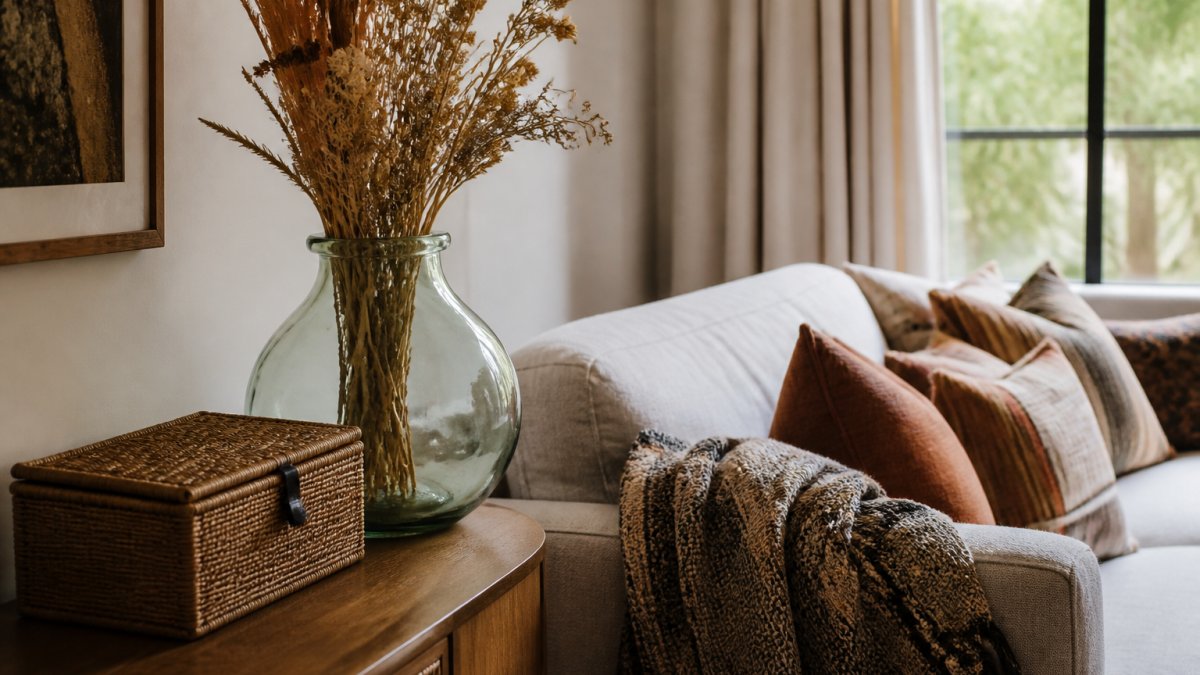
Work surface by surface, largest to smallest:
- Sofa: two or three throw pillows in mixed textures, not matching sets. Vary the sizes (for example, a 20-inch square behind an 18-inch square) so the grouping has a clear front and back.
- Coffee table: one statement piece plus a stack of two or three books. Keep the stack shorter than the table is wide so there is room to set down a drink.
- Console or sideboard: one tall piece (a vase or lamp), one low piece (a bowl or tray), and one vertical element (a leaning framed textile). This triangle of heights is what makes a console look styled instead of staged.
- Walls: one woven hanging or framed textile as a focal point. Resist filling the wall around it; the empty space is what makes the piece read as art.
- Floor: a woven basket for throws or magazines. A basket beside a chair does double duty as storage and as a way to soften a hard floor.
A few living-room-specific moves that competitors rarely spell out:
- Anchor the seating. Place the largest textile (a rug, a throw, or a wall hanging) so it visually connects the sofa to the coffee table. A rug that runs under the front legs of the sofa and stops short of the far wall makes the seating area feel intentional.
- Repeat one material three times. If you use wood on the coffee table, echo it in a frame and a bowl. Three repeats read as a theme; two read as a coincidence.
- Leave one surface empty. A single clear surface (an end table, a shelf) gives the eye a rest and makes the styled surfaces around it look deliberate.
For a statement vase, a hand-blown glass piece in a swirl pattern adds color without weight. A guide to glassware care from The Corning Museum of Glass explains why hand-blown glass shows small bubbles and uneven walls. Those marks are signs of hand work, not flaws.

How to Style Handmade Pottery, Vases, and Textiles
Handmade pottery, vases, and textiles follow the same styling logic: one hero, a supporting texture, and open space. Group them by material so the eye reads them as a set, then size and place each piece with intent.
Eastern Retro Hand Blown Glass Vase Yellow W/Blue Green Swirl 8” →
Vases: Use odd numbers. A single tall vase works alone. Three small vases of different heights work as a group. As a rule of thumb, the tallest vase in a group should be roughly twice the height of the shortest so the grouping has a clear top and bottom. Fill them with dried stems, a single branch, or nothing at all.
Pottery: Place bowls and plates where they get used, not just seen. A ceramic bowl on a kitchen counter or entry table looks intentional. A shelf of unused pottery looks like storage. Stack two or three bowls of graduated size and top the stack with a smaller piece so the eye climbs rather than stalls.
Textiles: Layer a woven throw over a chair back, drape a runner across a table, or hang a block-printed panel on a wall. Textiles soften hard surfaces like glass and metal. A throw folded in thirds and draped over one arm of a chair reads as styled; the same throw spread flat reads as laundry.
Mix at least two materials in every grouping. Ceramic next to wood. Woven grass next to glass. The contrast is what makes each piece read as handmade.
A repeatable process for any grouping of pottery, vases, and textiles:
- Pick the hero. Choose the largest or most textured piece and place it first.
- Add a supporting texture. Bring in one piece in a contrasting material (wood, glass, metal, or fiber).
- Add height. Place one taller element behind or beside the hero so the grouping has a vertical line.
- Leave negative space. Keep at least one hand-width of empty surface around the group.
- Edit once more. Remove anything that does not add texture, height, or color.
Care and upkeep for natural materials:
- Unglazed pottery and earthenware: wipe with a dry cloth; avoid soaking, which can cause hairline cracks over time.
- Glazed ceramics: most are dishwasher-safe, but hand-washing preserves the glaze and any hand-painted detail.
- Woven textiles and baskets: keep out of direct sun to slow fading, and dust with a soft brush rather than a damp cloth.
- Wood pieces: re-oil occasionally with a food-safe oil if the surface looks dry, and keep away from radiators and direct heat.
How to Identify Quality Handmade Decor Before You Buy
Quality handmade decor shows tool marks, slight unevenness, and weight in the hand. Those are the signs of a person, not a machine.
Check these details before you buy:
- Look for small variations between pieces, not perfect copies
- Feel the weight; solid pieces feel heavier than they look
- Check joins and seams for clean, tight work
- Turn it over and look for a maker's mark or signature
- Ask what the piece is made of and how to clean it
- Confirm the return policy before you commit
A common mistake is paying artisan prices for factory goods with a rustic finish. Real handcraft carries small irregularities. Uniformity is the tell.
For shoppers who want to see the piece in person, buying from a local maker or a shop that carries local work removes the guesswork. Frijja stocks handcrafted decor and limited antiques, so you can check the weight, finish, and markings yourself before buying.
Scale, Placement, and Visual Balance in Artisanal Home Decor
Scale and placement decide whether a handmade piece looks collected or crowded. Get the size right first, then place it where the eye naturally rests.
Use these guidelines:
| Element | Target Size | Best Placement |
|---|---|---|
| Wall hanging | Two-thirds the width of the furniture below | Centered above sofa or console |
| Table vase | One-third the table height | Off-center, never dead middle |
| Shelf group | Varied heights, tallest at back | Anchor one end, leave the other open |
| Floor basket | Knee height or taller | Beside seating or a doorway |
Visual balance does not mean symmetry. A heavy piece on one side can be balanced by two lighter pieces on the other. Step back and squint. If one side pulls your eye too hard, add weight to the other.
Frequently Asked Questions
What is the 3-5-7 rule in decorating?
The 3-5-7 rule is a styling guideline for arranging objects in odd-numbered groups. Place three items together for a small vignette, five for a medium surface like a console, and seven for a large display such as a bookshelf. Odd numbers create visual balance because the eye cannot pair them symmetrically, so it moves across the arrangement instead. When styling artisanal home decor, group a vase, a candle, and a small sculpture as your three, then add books or a woven box to reach five.
How do you mix handcrafted decor with modern furniture?
Start with one or two handmade pieces per room and let the modern furniture stay neutral. A hand-blown glass vase or a carved mango wood vase on a clean-lined console adds warmth without competing with sleek surfaces. Match scale rather than style: a large artisanal piece next to low-profile modern seating reads intentional, while several small handmade items scattered around look accidental. Keep your color palette to two or three tones so texture, not color, does the work.
How can you tell if a home decor item is genuinely handmade?
Look for small irregularities that machines do not produce: slight variations in glaze, uneven hand-painted lines, visible tool marks, or a signed backstamp. A ceramic vase with a painted backstamp and artist signature, like the Yellow Leaf W.M.G. Asymmetric Vase, shows a human hand was involved. Ask about materials and origin, check whether the seller names the technique used, and feel the weight. Genuinely handcrafted pieces often carry a maker's mark or a story about where and how they were made.
How do you style artisanal home decor without making a room feel cluttered?
Follow a one-in-one-out approach and limit handmade pieces to three to five per room. Give each piece breathing room: leave at least a hand's width between objects on a shelf or table. Use a woven grass box with a lid to store smaller items so surfaces stay clear while the texture still shows. Stick to a single color palette across your artisanal pieces, and let one item per surface act as the focal point rather than filling every gap.
Styling a room with handmade pieces takes a plan, not a big budget. The process is simple: pick a focal point, build texture, and edit until the room feels calm. Frijja carries handcrafted home decor and limited antiques, including a hand-blown glass vase, a carved mango wood vase, and a woven grass storage box, all made by local artisans and priced for real homes. Shop All and find the piece that starts your next room makeover.
0 comentários